Thursday, August 21, 2014

Nepal


Nepal is a landlocked sovereign nation located in South Asia. With an area of 147,181 square kilometres (56,827 sq mi) and a population of approximately 27 million. Nepal is the world's 93rd largest country by land mass and the 41st most populous country. It is located in the Himalayas and bordered to the north by the People's Republic of China, and to the south, east, and west by the Republic of India.
The mountainous north of Nepal has eight of the world's ten tallest mountains, including the highest point on Earth, Mount Everest, called Sagarmatha.  


The landscape of Nepal was a stark contrast to arid Tibet as the first two pictures show. Our guide told us that Nepal is focused on two economic goals, increase tourism and develop hydroelectric power for Nepal and to export.


Kathmandu is the capitol of Nepal. Our guide said that during the 60's and 70's it was a popular place for flower children. Marijuana was legal and plentiful. Our guide showed us marijuana growing along the side of a road we were traveling. He said the psychedelic patterns on vehicles we saw originated during this time.


In Kathmandu we saw many children in school uniforms. We were told those in uniform go to private schools. Other children attend public schools. Sadly, many children do not attend school at all.


One of the highlights of the trip for me was seeing Rotary in action, as shown by this sign in Kathmandu.


These students were waiting to attend the school sponsored by the Rotary Club.


I have not been to India, but Nepal had the feel of the India I have seen in the media.


There are many Hindu and Buddhist sites in Nepal. Our guide told us that Nepal is 90% Buddhist and 90% Hindu, meaning the two religions get along in Nepal.


Cows are sacred here. We did not see beef on the menu. 

Monkeys were as plentiful as stray dogs in some areas.


Women obtaining and carrying off water from a public water source.


We left Nepal with gratitude for our own circumstances and more respect for other cultures.


Sunday, August 10, 2014

Tibet


Tibet is a region governed by China. Before we went to Tibet, we were told about the symptoms of being at high altitudes, shortness of breath and headaches, to name two. One of our Chinese friends obtained a prescription for us to take before our journey that was supposed to lessen the symptoms. With our experience living at what we thought we high altitudes in the Mountain West and our Chinese prescription, we flew to Lhasa the capital of Tibet, whose elevation is over 11,000 feet. The prescription and experience were no match for altitudes that in some areas where we traveled exceeded 15,000 feet.


We are standing in front of one of the most sacred places for Buddhists, the largest Buddhist temple in Lhasa. Many people who had made a pilgrimage to to this site were walking around and around the temple when we arrived. Many brought offering for the temple, including yak butter that was fuel for candle-like light in the temple.


 It is probably difficult to overestimate the significance of the temple at Lhasa to many who worship there.


This view gives a better idea of the size and complexity of the structure. We are standing in a large square. While we were there,  two soldiers asked to have their picture taken with me.  This was a real surprise because everywhere we have been in China we have not been allowed to take pictures of the military.

Tibetan women that we saw were in there traditional dress. The men often wore western clothes.

 We saw many yaks along the way. We had yak to eat and it tastes like beef.

Here it is! Mount Everest on the Tibetan side. It is a breathtaking view, literally. Altitude symptoms are real. I had shortness of breath and Marilyn had headaches. But all that we saw and experienced eclipsed a little discomfort.

On the way back from the base camp of Mount Everest we happened on a local festival. Everyone seemed to be having a good time.


The northern side of the Himalayas is desolate. We saw very little wild life. 


 As we crossed the summit on our way to Nepal the vegetation became lush and the waterfalls sere stunning.

 We say good-by to our guide, center, our driver, and Tibet before crossing the border to Nepal.

Sunday, May 25, 2014

Cambodia Angkor Temple Ruins

A little background information from Wikipedia about the area in Cambodia we visited:

Angkor (Khmer: "Capital City") is a region of Cambodia that served as the seat of the Khmer Empire, which flourished from approximately the 9th to 15th centuries. The Angkorian period began in AD 802, when the Khmer Hindu monarch Jayavarman II declared himself a "universal monarch" and "god-king", and lasted until the late 14th century, first falling under Ayutthayan suzerainty in 1351. A Khmer rebellion resulted in the 1431 sacking of Angkor by Ayutthaya.
The ruins of Angkor are located amid forests and farmland to the north of the Great Lake (TonlĂ© Sap) and south of the Kulen Hills, near modern-day Siem Reap city in Siem Reap Province. The temples of the Angkor area number over one thousand, ranging in scale from nondescript piles of brick rubble scattered through rice fields to the magnificent Angkor Wat, said to be the world's largest single religious monument. Many of the temples at Angkor have been restored, and together, they comprise the most significant site of Khmer architecture. 


This tomb raider failed to maintain a low profile.

 There are international organizations devoted to preserving and restoring these amazing temple sites.
We climbed some stairs as steep as these to see some views from the top. 


This view shows some of the scaffolding used to restore the ruins as well as parts before restoration. 

Our guide saved the most spectacular sites for the last day. Temples overgrown by the forest have a surreal appearance.  


This pictures gives you a idea of the size of some of the tree roots. 


At another place in Cambodia this girl waits for tourists with her pet snake hoping to make some money selling pictures.

In Cambodia we used American money. When we arrived in the country we found an ATM after we deplaned. To our surprise, it dispensed U.S. dollars, some of which we had to use to pay for our visa to enter the country. We continued to use U.S. dollars during our stay, although we would sometimes receive Cambodian money for change.

We thought the parts of Cambodia we visited seemed less prosperous than Vietnam. Unlike Vietnam and China, we saw children who appeared to be school age who were not in school. Also, unlike Vietnam and China, we saw many children, again young children who should have been in school, selling trinkets for "a dollar, a dollar." 

We found many American products in stores and most were less expensive than what the same think would cost in China. We also found a great hamburger and fries after our trek in the "jungle."


Sunday, February 23, 2014

Ho Chi Minh City/Saigon and Surrounding Area


Ho Chi Minh City is still called Saigon by many of its residents, and it is a bustling, lively place with many foreign tourists and a developed tourist economy.  French influence, as seen in some architecture still remains.        

It seemed unusual to be in a country where this national symbol is frequently and prominently displayed.

A view of the skyline from the river. 

 
In a place somewhat removed from Saigon we took a boat to an area where coconut products were produced.  The captain's daughter took a turn at the wheel when the boat was docked.

Our guide, whose English name is Happy, telling us about how coconuts are processed and about the many uses of coconuts.


The entry to a very large wholesale market in Saigon.  One could not purchase one hat here, but several boxes of hats could easily be purchased.


Some of the varied items in the wholesale market.


Another view of the wholesale market.


The opera house in Saigon.  We saw a performance of young dancers/musicians/acrobats/gymnasts/actors who exhibited wonderful talent in a creative production.

An exhibit outside of the war museum in Saigon.  The story told at this museum was not pleasant and was, of course, one side's version of what happened.

One room in the former presidential palace.  The building was indeed palatial. 

A Catholic church in downtown Saigon that was constructed in the 1800's. 

Sculpted fruit for dessert at a Saigon restaurant that served delicious food.

Sunday, February 16, 2014

Hanoi and Surrounding Area

 
During the break between semesters we traveled some with other BYU China teachers.  One tour was to Vietnam and Cambodia.  This post is limited to Hanoi and its surrounding area.  For Marilyn's and my generation, Vietnam signifies more than a country.  Vietnam is an emotionally charged word and I expect it always will be.  No matter what one's view is about the Vietnam conflict, I think all would agree that it had a profound impact on America.


A hostess at one of restaurants we enjoyed.  The people in Vietnam are very gracious, and the service in hotels and restaurants is superb.
 
 
A view across the way from in front of the Hotel in Hanoi where we stayed.
 
Scooters seem to be the main form of transportation.  They are everywhere.  In Vietnam people seem to pay more attention to traffic signals than they do in Nanjing.  In Nanjing there are may electric scooters and most are used on sidewalks.  They travel silently, and it is extremely important to walk in a predicable way.  In Vietnam the scooters are gas powered and stay on the streets.


Scooters are for families too, as you can see, and this was not an unusual scene. 


The Hanoi Hilton, a place I never thought I would visit. 
 
This prison was first operated by the French to house Vietnamese political prisoners.  Later it was where American POW pilots were kept.  Each side has its own version of the conflict, and the American version is not told here.  Most of the displays had more to do with how the French treated the Vietnamese than about the conflict with America.


As we travelled by bus from Hanoi to a scenic bay, we passed many rice fields.  We were told that in some areas of Vietnam three crops of rice are raised in a year.


We stopped at a pearl harvesting  operation. 

 
There was a separate show room with pearl jewelry for sale.  We looked but did not buy.


Halong Bay is beautiful


Dinner on the boat. 
 
All of the food in Vietnam was good.  It seemed light and fresh.
 

Another traveler.


One of many scenic views of the bay.


The view out the window of the hotel room where we stayed near the bay.
(I hope everyone appreciates the sacrifices we make on these trips.) 
 

Friday, January 31, 2014

Sun Yat-sen

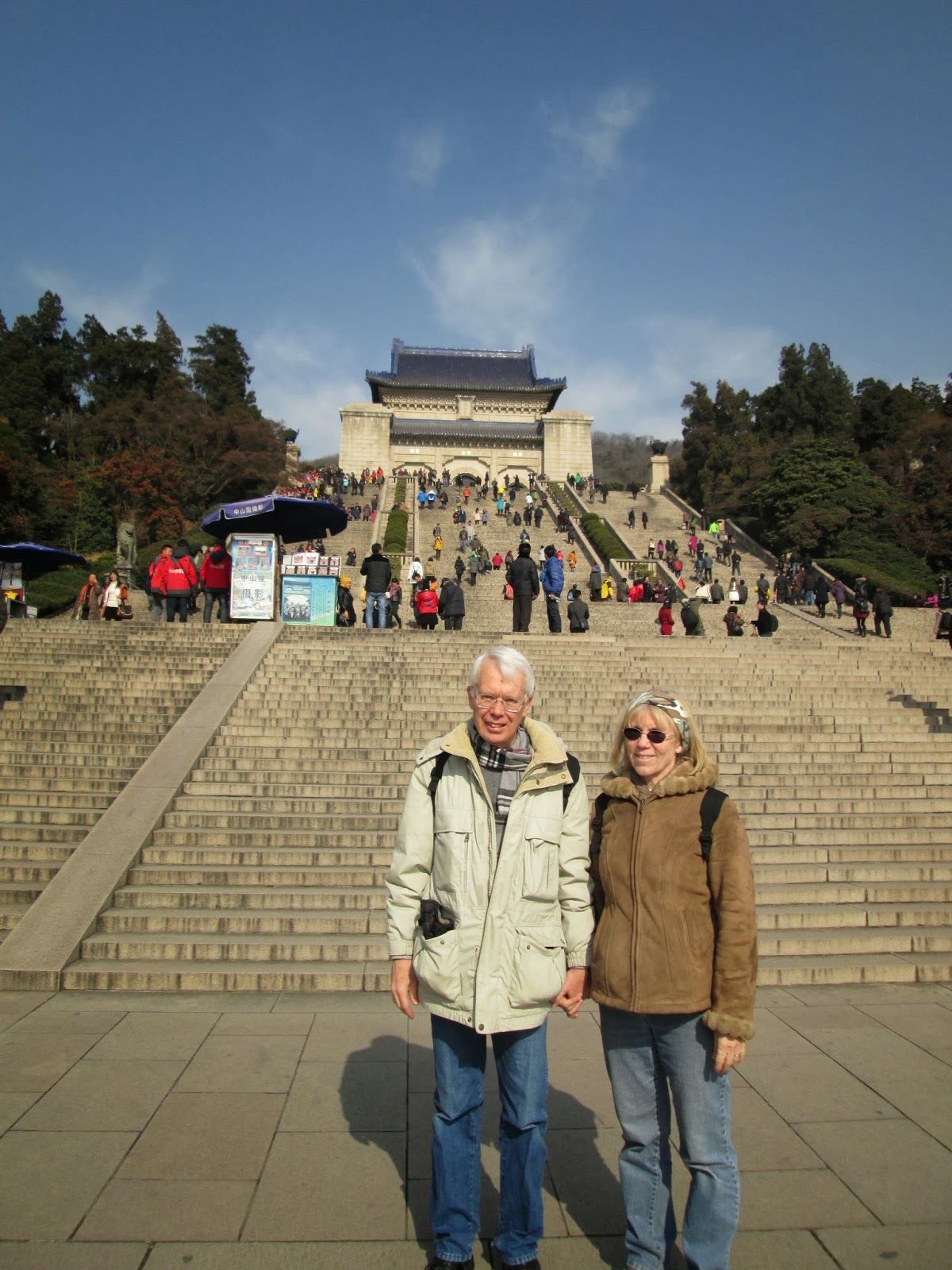
After the first semester ended some law students took us to the Purple Mountain in Nanjing.  While there we saw the Sun Yat-sen memorial.

"Sun Yat-sen (12 November 1866 – 12 March 1925) was a Chinese revolutionary, first president and founding father of the Republic of China ("Nationalist China"). As the foremost pioneer of Republic of China, Sun is referred to as the "Father of the Nation" in the Republic of China (ROC), and the "forerunner of democratic revolution" in the People's Republic of China. Sun played an instrumental role in the overthrow of the Qing dynasty during the years leading up to the Double Ten Revolution. He was appointed to serve as president of the Provisional Republic of China, when it was founded in 1912. He later co-founded the Kuomintang (KMT), serving as its first leader. Sun was a uniting figure inpost-Imperial China, and remains unique among 20th-century Chinese politicians for being widely revered amongst the people from both sides of the Taiwan Strait."

We learned that the Chinese people hold Sun Yat-sen in high regard, somewhat like how we honor George Washington.  Interestingly those in Taiwan revere him in the same way and many travel to Nanjing and his memorial. Nanjing was the capitol of China until the current regime came to power in the late 1940's and moved the capitol to Beijing.


Here we are with our wonderful guides who are all post law degree graduate students at Nanjing University. Unlike in America, students begin studying law their first year at the university.  After earning a law degree, many continue to earn graduate degrees.  It was particularly interesting to learn the opinions of these students as they showed us sites with great political and historical significance.


At the bottom of the memorial, determined to make the climb.


A view from the top.  We were not allowed to take pictures of the actual memorial.  It is is somewhat like the Lincoln Memorial in Washington D.C.


The same day we hosted an American party for other Chinese students at our apartment.  These students were on one or the other moot teams I assisted earlier.  We had a fun time with American food and games. We even found some root beer to serve. The highlight of our experiences in China is our association with students.  They have been very kind and helpful to us and we enjoy our time with them both in and out of the classroom.    

Sunday, January 19, 2014

International Arbitration Moot in Beijing

We would like to post more often, but we often have difficulty accessing Blogger.

After Marilyn and I traveled to Shanghai with a moot court team as reported in our last post, I was asked to help with an international commercial law arbitration moot.  This moot was also held in English, otherwise I would have been useless.  The team needed a faculty adviser to accompany them to Beijing, and I was fortunate to be that person.  I spent an enjoyable week in Beijing with eight students learning much.  Four of the students participated in the arbitration presentations, two teams of two, and four students were researchers with one of those being our treasurer and administrator. Unfortunately, Marilyn needed to stay in Nanjing to teach her classes.

The competition, except for the championship round, was held at the building that houses the national Chinese arbitration association.  This competition was the Chinese preliminary round to the the world-wide Willem Vis international commercial arbitration moot competition. Teams from all over the world, including the United States, compete in this competition.  The final world-wide competition is held in Vienna, Austria, and there is also an Asian competition held in Hong Kong.  The winner of the Beijing competition will go to Vienna to compete and the second place team will go to Hong Kong to compete. We will not be going to Vienna or Hong Kong.

The arbitration panels were mostly Chinese arbitrators and attorneys with a few arbitrators from other countries.  The chairman of the panel that judged the final round was a professor from Sweden. 

Arbitration is becoming a more popular form of dispute resolution and I expect international commercial arbitration will become increasing popular and competent arbitrators and attorneys will also be in greater demand.  China is determined to be a world player in this field and is committed to constant improvement with a goal of being a venue of choice for international commercial arbitration.  


The arbitration building in Beijing where all but the final round was held.


Our team with one of the arbitration panel members who is from Hong Kong.

Mental work is of course hard work requiring adequate nourishment and in Beijing we found what was needed to keep up our strength.  I was very fortunate to have these students as guides.  We went to restaurants that were wonderful and that I doubt many tourists would ever find.